
By Tom Reburn | REALTOR® | Century 21 United Realty | Peterborough, Ontario
There's a question I want more people to start asking themselves.
Am I waiting for the best interest rate, or am I waiting for the best opportunity to buy a home?
Because those two things don't necessarily happen at the same time.
In our recent conversation for Get Off the Sidelines, our homeownership series in partnership with BRX Mortgage, we talked about the importance of understanding your numbers, developing a game plan and recognizing opportunity.
And I think it's time we had a more candid conversation about what opportunity actually looks like in today's real estate market.
The Hard Truth About Today's Real Estate Market
Decreasing home prices aren't necessarily bad news. It depends entirely on which side of the transaction you're standing on.
For someone trying to enter the housing market, move into a larger home or purchase an investment property, declining prices can create opportunities that simply weren't available a few years ago.
There are homes for sale in Peterborough that have been sitting on the market for over 100 days without a single price adjustment.
Think about that for a moment.
Over three months of market exposure, potentially multiple showings, changing market conditions and, in some cases, an asking price that hasn't adapted to what buyers are willing to pay.
The asking price is not necessarily the market value. And it certainly isn't always the price you need to pay.
That's where understanding the market becomes important.
A home sitting on the market for 100 days doesn't automatically mean it's a bad home. It could be overpriced, poorly positioned, marketed ineffectively or simply overlooked.
For a prepared buyer, that could represent an opportunity.
Everyone Wants to Buy Low — Until the Market Actually Goes Down
One of the interesting things about real estate is how much consumer confidence influences decision-making.
When prices are rising, people are afraid of missing out.
When prices are falling, people are afraid of making a mistake.
Yet, when you remove the emotion from the equation, a less competitive market may offer buyers some of the very things they were desperately looking for during a hot market:
More time to make informed decisions.
Greater negotiating power.
Less competition from other buyers.
Opportunities to negotiate financing and inspection conditions.
The ability to walk away from a deal that doesn't make financial sense.
Potentially lower purchase prices.
These are meaningful advantages.
But because the general sentiment surrounding the market is negative, many buyers struggle to recognize them.
Opportunity doesn't always arrive with confidence, excitement and positive headlines. Sometimes it arrives quietly, when everyone else is standing on the sidelines.
You Can Renegotiate Your Mortgage. You Can't Renegotiate Your Original Purchase Price.
I understand why people are watching interest rates so closely. They have a significant impact on affordability, monthly payments and household budgets.
But interest rates are only one part of the equation.
Your purchase price matters. Your down payment matters. Your borrowing costs matter. The condition of the property matters. And the terms you're able to negotiate matter.
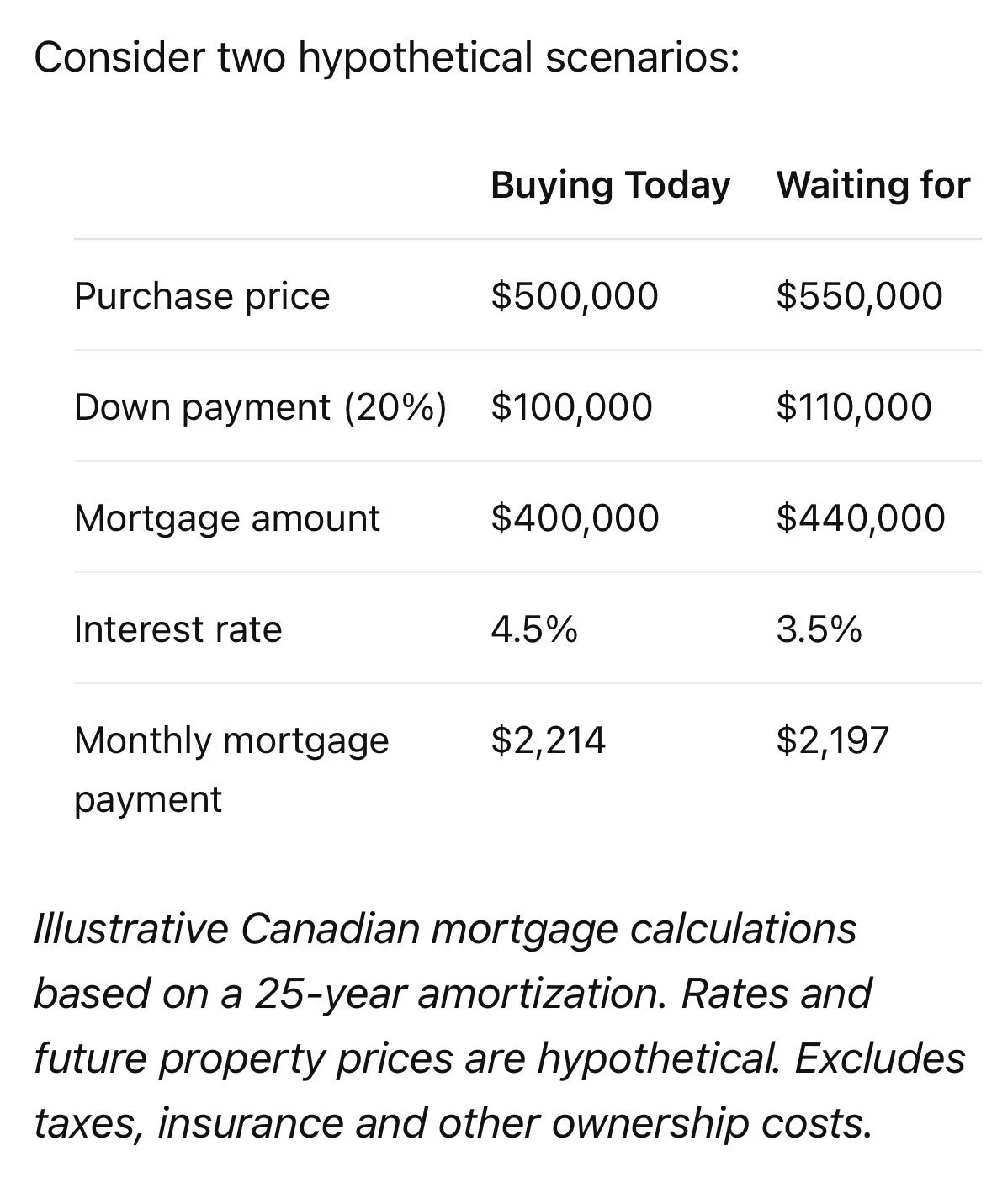
In this example, waiting for an interest rate that's a full percentage point lower saves you approximately $17 a month on your mortgage payment.
But you've paid $50,000 more for the property, contributed an additional $10,000 toward your down payment and taken on $40,000 more in mortgage debt.
I'm not suggesting that prices will increase when rates decrease. Nobody can guarantee that.
What I am suggesting is that waiting for a lower interest rate without considering the potential changes in property prices and buyer competition is an incomplete financial strategy.
Your mortgage rate may change at renewal or through refinancing, subject to qualification and lending conditions.
Your original purchase price is permanent.
This Is Where Choosing Your REALTOR® Matters
In a market like this, I believe the value of your REALTOR® becomes particularly important.
Getting you through the front door of a property is the easy part.
Understanding what that property is worth, why it hasn't sold, how it's positioned against comparable properties and where there may be room to negotiate is where the real work begins.
When I'm evaluating a property with a buyer, I want to understand:
How long has the property been on the market?
Has the asking price changed?
What have comparable properties actually sold for?
Has the property been previously listed?
What can we learn about the seller's circumstances through appropriate channels?
What expenses might the buyer face after closing?
What terms could make our offer more attractive without unnecessarily increasing the purchase price?
Negotiation isn't simply about submitting a lower offer and hoping the seller accepts it.
It's about building a position supported by information, understanding the circumstances and knowing when to push, when to compromise and when to walk away.
Sometimes the best thing I can do for a client is help them recognize an opportunity.
Sometimes it's helping them recognize that something isn't one.
Both are equally important.
Getting Off the Sidelines Doesn't Mean You Have to Buy
One of the biggest misconceptions I encounter is that starting a conversation with a REALTOR® or mortgage professional means you're committing to buying a home.
It doesn't.
It means you're choosing to understand your position.
Maybe you need to pay down some debt. Maybe you need to adjust your savings strategy. Maybe you're closer to qualifying than you thought. Or maybe the numbers tell us that waiting another year is genuinely the best decision for your family.
All of those are valuable outcomes.
What concerns me is when people make the decision that homeownership isn't possible without ever actually running the numbers.
There's a difference between making an informed decision to wait and standing still because you're afraid of what you might find out.
Behind Every Purchase Is Something Bigger Than a House
As much as I talk about numbers, negotiation and protecting your investment, I also understand that buying a home is deeply personal.
It's not just a mortgage payment.
It's the backyard where your kids might grow up.
It's the kitchen where your family gathers on Sunday mornings.
It's finally being able to paint the walls whatever colour you want, plant a garden or hang something on the wall without asking permission.
It's the feeling of turning into your driveway after a long day and knowing you're home.
For some people, it's independence. For others, it's stability, a fresh start or the opportunity to build something for the next generation.
That's why I don't believe buying a home should be driven entirely by market headlines, nor should it be driven entirely by emotion.
The numbers should support the life you're trying to build.
Not the other way around.
My job isn't to convince you to buy a house. It's to help you make a decision that you can feel good about financially and personally, long after the keys have been handed over.
You Don't Need to Time the Market Perfectly
You need to understand your own financial position, recognize what represents value and surround yourself with people who are working in your best interest.
The right opportunity isn't necessarily the cheapest house, the lowest interest rate or the perfect moment in the market.
It's the intersection of financial readiness, a well-negotiated purchase and a home that makes sense for the life you want to live.
If you've been sitting on the sidelines watching the Peterborough and Kawartha Lakes real estate market, wondering when the right time might be, I encourage you to start with a conversation.
No pressure. No commitment. No expectation that you need to buy tomorrow.
Just clarity, a game plan and a better understanding of what's possible.
Let's run the numbers.
THE HOME BUYING PLAYBOOK™
Stop waiting for the perfect market.
Start building your game plan.
Understanding your numbers, recognizing opportunity and knowing how to negotiate can make a meaningful difference in what you pay for your next home.
Download my free Home Buying Playbook™ and start approaching the Peterborough real estate market with a strategy.
— Tom Reburn
REALTOR® | Century 21 United Realty
Rooted in the Patch
www.tomreburn.com
